Research and Development
We explore innovative materials and techniques for cultural heritage preservation
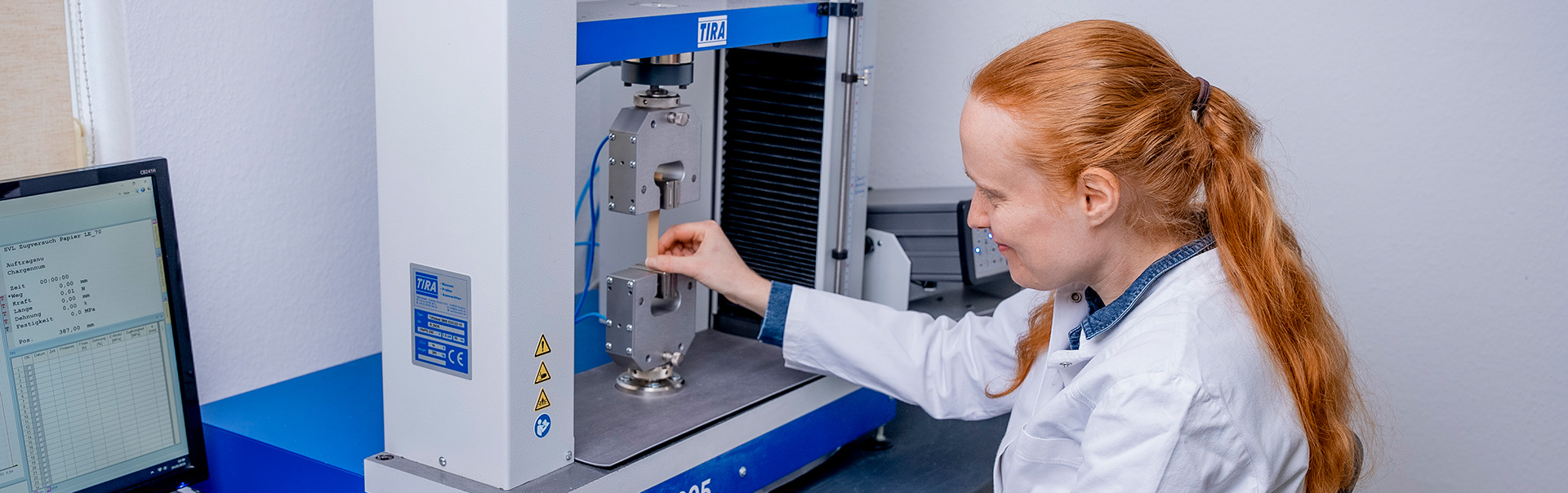
In our research and development department, our scientists are constantly working on solutions to preserve your valuable originals. Whether paper, leather, cellulose, stone or metal – we are conducting research on many projects to rescue historical cultural assets.
Research and Development
For us, research and development means constant progress and, above all, the further development and growth of our expertise in order to continually develop innovative and reliable solutions for a wide range of problems in the field of conservation and restoration – always with the aim to permanently preserve your valuable originals.
Our research work focuses primarily on papers such as fragile newspapers, archived files, historical business documents and, of course, books and their bindings from all eras and styles.
In addition, we also deal with the long-term preservation of cultural assets made from other materials, such as leather, canvas, metals and even stones from listed buildings and objects.
Our goal is, in particular, the (further) development of practical, sustainable, but also economical materials and technologies that are suitable for treating large quantities.
Over the past decades, constructive cooperation with numerous universities, research institutes and collections has given us access to an international research network. This allows us to access and participate in the latest developments in the international heritage science community and ultimately transfer them into restoration practice.
In close cooperation to our sister company ZFB Projekt Management GmbH, which specialises in process development, design and mechanical engineering, the newly developed technologies are implemented in innovative systems for bulk material handling – from special-purpose machine construction to series production.
Increasing the environmental resilience of valuable cultural assets in natural science collections
With the aim of strengthening the environmental resilience of valuable and sensitive collection objects against challenging climatic conditions and thus preserving them in the best possible way for future generations, three innovative approaches shall be transferred into conservation practice using historical mammal skins as a model:
- Methods for temporarily and gently increasing the flexibility of rigid organic objects in order to transfer them to a permanently favourable form of storage and use
- pH adjustment of the objects to slow down the progressive material degradation caused by
aging and environmental processes
- Object packaging that is independent of the ambient climate and can be adapted to specific materials
The results are practically proven processes and products, decision-making aids for risk assessment, workflows, and concrete work instructions for conservation measures.
The two-year project is procesed since January 1st, 2026, in collaboration with the Museum für Naturkunde Berlin.
We would like to thank the Deutsche Bundesstiftung Umwelt (DBU) for funding this project.
![[Translate to Englisch:] Logo Förderung durch die Deutsche Bundesstiftung Umwelt](/fileadmin/_processed_/8/a/csm_png-DBU-Logo-gefoerdert-durch-RGB_91d034b78f.png "[Translate to Englisch:] rung durch die Deutsche Bundesstiftung Umwelt")
GREen ENdeavor in Art ResToration
The overall objective of the project was to develop sustainable, environmentally friendly materials and for the safe and effective conservation, active restoration, or passive preservation of cultural assets.
The ZFB is particularly interested in materials for the production of archival cardboard for long-term archiving. On the one hand, the potential of annual plants (hemp, flax, bamboo, cup plant, or agricultural residues such as bagasse) as a basis for corrugated cardboard production has been investigated in order to reduce their wood (fresh) fibre content. Of course, restoration requirements still had to be met. In line with more sustainable production and distribution processes, this should significantly reduce the CO2 and water consumption of protective packaging, making passive preservation even more environmentally friendly.
In addition, the use of recycled or bio-based plastics as a possible raw material for more durable, emission-free, and thus “greener” archive packaging was also investigated. The possibility of a refreshing treatment for old, mostly acidic archive boxes was also examined. All methods developed in the project were evaluated for their sustainability through extensive lab assessments and a final life cycle analysis (LCA).
The three-year project has been running since October 1st, 2022, in collaboration with 26 European partners under the leadership of the Centre for Colloid and Surface Science (CSGI).
We would like to thank the European Union for funding this project.
![[Translate to Englisch:] Logo Greenart](/fileadmin/_processed_/b/f/csm_GREENART_LOGO_7029442564.jpg "[Translate to Englisch:] Logo Greenart")
![[Translate to Englisch:] Logo Förderung durch die Europäische Union](/fileadmin/_processed_/4/3/csm_EN_fundedbyEU_VERTICAL_RGB_POS_c3065906ef.png "[Translate to Englisch:] Logo Förderung durch die Europäische Union")
NANOhyd
Consolidants for the preservation of Lime and cement plaster based on dispersions of nano-lime and hydraulic binders
The aim of the project was to develop innovative modular fixatives for the sustainable preservation of historic plaster. These consolidants have a variable composition and are designed according to a modular principle. The basis for the consolidants, which can be adapted to the respective building material, are nano lime and other nanodispersions from various hydraulic binders. The system was developed during the NANOBINDER feasibility study and has been tested and further investigated under real conditions in the NANOhyd project.
The two-year project has been carried out since January 1st, 2024, in collaboration with certified restorer Martin Fliedner and LandVogtLand e.V., and supported by the “Verein zur Erhaltung des Rittergutes Kleingera e.V.” (Association for the Preservation of the Kleingera Manor) as an associated partner.
We would like to thank the German Federal Ministry of Research, Technology and Space for funding this project as part of the WIR! alliance of the “Vogtlandpioniere” (Vogtland pioneers).
![[Translate to Englisch:] Logo Wandel durch Innovation in der Region](/fileadmin/_processed_/6/1/csm_wir-logo_600x400_cfd8182c62.png "[Translate to Englisch:] Logo Wandel durch Innovation in der Region")
![[Translate to Englisch:] Logo Vogtlandpioniere](/fileadmin/_processed_/a/a/csm_logo-vogtlandpioniere_900x600_5a52815a7c.png "[Translate to Englisch:] Logo Vogtlandpioniere")
Feasibility study on novel hydraulic binders for stone conservation based on nano-lime
The aim of the project was to develop novel binder systems for a sustainable consolidation and stabilization of historical and modern building materials. The development of a deep-acting application method and the optimization of the binder's bond to the original substance should enable a more effective and sustainable treatment compared to existing benchmark systems.
The novel binder systems were first to be evaluated in a feasibility study for selected building material classes on a laboratory scale using model rocks. Following the positive results of the study, the further development and application of the novel consolidation systems at the Liebau mansion and the Kleingera manor as regional demonstration objects has been pursued in a follow-up project (NANOhyd).
The 18-month feasibility study has been conducted since January 1st, 2022, in collaboration with certified restorer Martin Fliedner.
We would like to thank the German Federal Ministry of Education and Research for funding this project as part of the WIR! alliance of the “Vogtlandpioniere“ (Vogtland pioneers).
![[Translate to Englisch:] Logo Bundesministerium für Bildung und Forschung](/fileadmin/_processed_/4/4/csm_BMBF_gefoerdert_vom_deutsch_b7245a170e.png "[Translate to Englisch:] Logo Bundesministerium für Bildung und Forschung")
Development of a novel enzyme-based decontamination method for documents severely damaged by microbes, using historically valuable manuscripts and printed works as examples
Ongoing climate change poses new challenges for the protection of cultural assets, which are also evident in the conservation and restoration of objects. In addition to fire damage, water and moisture damage are a serious problem for written documents. Persistently unfavourable or temporarily extreme indoor climates can also lead to serious mould damage, which can result in complex damage patterns. Such damage has occurred in the past and not only endangers cultural property, but also poses a health risk to everyone in cultural institutions.
At the start of the project, the current state of research did not offer any treatment methods that could kill mould components on paper objects in a pollutant-free, object-friendly manner and remove them thoroughly. Therefore, the aim of the project was to develop a new, practical and environmentally friendly method for dissolving and removing mould in order to restore and preserve such objects and to have suitable procedures ready for use in the event of similar damage in the future.
The two-year project has been running since May, 1st 2021 in cooperation with the Saxonian State Library – Dresden State and University Library (SLUB), the Institute for Wood Technology Dresden non-profit GmbH (IHD) and the Fraunhofer Institute for Silicate Research (ISC).
We would like to thank the German Federal Environmental Foundation for funding this project.
![[Translate to Englisch:] gefördert durch DBU](/fileadmin/user_upload/DBU.png "[Translate to Englisch:] Deutsche Bundesstiftung Umwelt")
Construction and commissioning of a production plant for the mechanical and mass suitable strengthening of paper for the sustainable stabilisation of aged paper
The aim of the project was to construct and commission a pilot plant for the mechanical application of stabilisers to strengthen and thus to preserve and maintain the usability of 19th and 20th century archive and library materials threatened by acid decay. The aim was to develop an effective and economically viable process for stabilising aged paper using the strengthening agent developed in the ‘PAPIERSTAB’ and ‘Stabilisierungsfilm’ research projects.
The 3 1/2-year paper strengthening plant project has been in progress since June 1st, 2019.
We would like to thank the European Union (ESFR) for funding this project.
Development of a biopolymer-based stabilisation film for an economical and sustainable stabilisation of aged paper in a laminating process
The aim of the project was to develop a novel, biopolymer-based stabilisation film that can be used in an industrial-scale, mass-production-compatible paper strengthening process to preserve and secure the usability of large quantities of 19th and 20th century archive and library materials threatened with decay. To this end, the aim was to apply the newly developed stabilising film in thin layers in the µm range to a carrier material, make it suitable for storage and transport, and laminate it onto aged paper in a separate process. Both the production of the raw materials and the strengthening film, as well as the lamination onto the papers to be treated, were to be carried out using effective and economically viable processes. The overarching goal remains the stabilisation of aged papers.
The two-year in-house project has been processed since November 1st, 2018.
We would like to thank the European Union (ESFR) for funding this project.
Stabilisation and conservation of fragile wood-containing papers through the use of innovative, biopolymer-based materials
The aim of this project was to develop and apply stabilisers that would help to preserve 19th and 20th century archive and library materials threatened by acid decay. The stabilising agent developed on the basis of renewable raw materials is intended to stabilise heavily aged and mechanically degraded wood pulp papers in such a way that their usability is sustainably restored while retaining their characteristic properties such as optical appearance, feel and consistency.
The two-year project has been running since March 14th, 2016 in collaboration with project partners the Fraunhofer Institute for Organic Electronics, Electron Beam and Plasma Technology, Dresden (FEP) and the Institute for Plant and Wood Chemistry at TU Dresden (IPHC). The Saxonian State Library – Dresden State and University Library (SLUB) also acted as a consultant.
We would like to thank the European Union (ESFR) for funding this project.
Sustainable care product system for treating vegetable-tanned book cover leather
The aim of the project was to develop a non-aqueous care product for treating aged book cover leather, enabling the long-term preservation of historically valuable, original book covers. Timely application of a sustainable treatment should enable damage-free use and preserve the functionality of the leather binding.
The three-year project has been running since January 1st, 2018 in collaboration with our project partner, FILK Freiberg Institute gGmbH.
We would like to thank the European Union (ESFR) for funding this project.